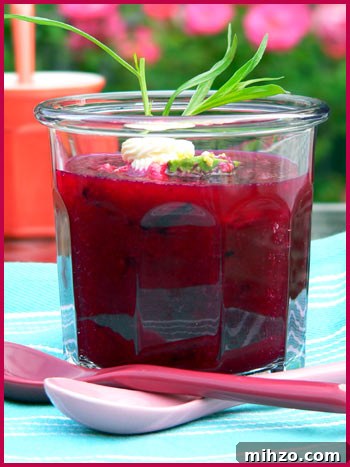
The Return of Cold Soups
When the weather turns hot, we naturally crave cooler foods. It’s fascinating to notice how outside temperatures influence what we eat. When my parents ask me, “Et quel temps il fait à Boston?” I always check their weather in return — it gives me a clue about what they’re likely eating. Years ago, while traveling in Turkey during summer, I struggled with warm dishes even when locals ate them. Not accustomed to the heat and still young, I didn’t handle the climate well. Summer is the season when I get excited about making cold dishes. There are countless recipes to try and an abundance of fresh vegetables and fruits to use. I love filling the table with salads, vegetable medleys, and other chilled creations, though I wish I had more hours in the day to make everything. My summer dishes tend to be bright and colorful—sun and heat inspire bold hues—and I’m especially happy that cold soups are returning to my table.
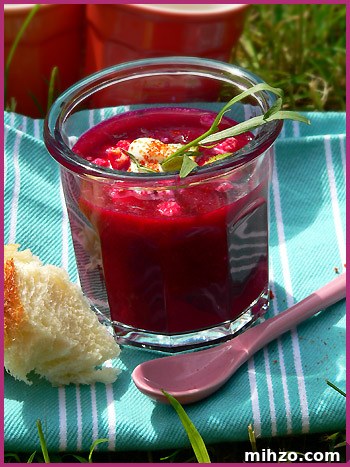
Borscht
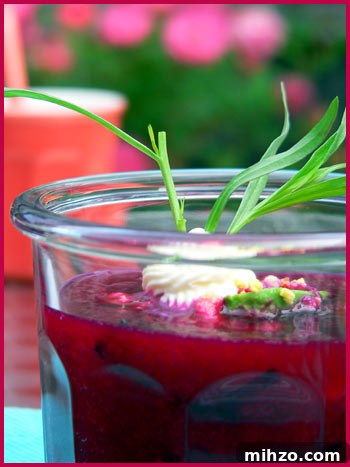
The first time I tasted borscht was on a hot summer day, and it was a cold version. What drew me in immediately was its striking deep red color. “Wouah,” I thought—this is pure red! That tasting stayed with me, and I promised myself I would recreate it at home. After several trials—adding and removing ingredients—I arrived at the recipe below. Borscht has many origins and regional variations across Eastern Europe: Russia, Ukraine, Belarus, Poland, Lithuania, Romania and beyond. Ukraine even claims borscht as its national soup.
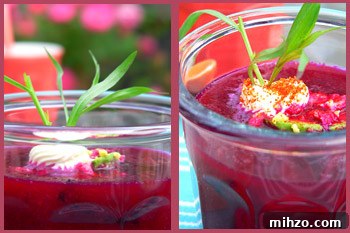
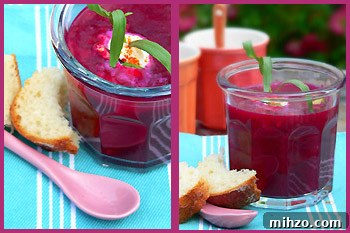
Borscht’s variations are many, but its essential ingredient is consistent: red beets. If you don’t like beets, this dish probably won’t win you over, though you might change your mind. I like my borscht with texture so it can be a meal on its own. I add chopped cucumber, avocado, tomatoes, and hard‑boiled eggs to the smooth beet broth, and finish it with a dollop of sour cream or crème fraîche. Purists might argue these additions aren’t traditional—“Mais c’est pas du tout du borscht ça!”—but I enjoy the contrast between crisp vegetable pieces and the silky cold beet base. Sour cream softens the soup while fresh herbs add perfume. A splash more sherry vinegar or lemon juice gives a tangy brightness I personally love. Serve it freely—it’s healthy and refreshing.
You need:
- 3 red beetroots (about 1 lb)
- Water (4 to 5 cups, or more)
- 2 scallions (or 1 shallot)
- 2 Roma tomatoes
- 1/2 English cucumber + 1/4 extra
- 2 eggs
- 1/2 avocado
- Salt and pepper
- 1 Tbsp sherry vinegar
- 1 Tbsp tarragon
- 1 Tbsp dill
- Sour cream or crème fraîche
- Juice of 1/2 lemon
- Dash of paprika (optional)
Steps:
- Brush and wash the beets thoroughly.
- Place them in a pot and cover with water (adjust quantity as needed).
- Add a pinch of sea salt and the lemon juice.
- Bring to a boil, then simmer on medium until beets are tender throughout (about 45 minutes to 1 hour, depending on size). Remove beets and reserve the cooking liquid to cool.
- Peel and coarsely chop the beets. Put most of them into a blender, leaving half a beet aside to add later with the other vegetables.
- Add some of the reserved cooking liquid to the blender to reach a smooth, balanced consistency—not too thin, not too thick.
- Peel the cucumber, remove the seeds, chop and add to the beet mixture, then blend again.
- Add the shallot (or scallions), tarragon and dill, and blend until smooth.
- Stir in the sherry vinegar, then season with salt and pepper.
- Transfer the soup to a container and chill in the fridge for at least 2 hours to let flavors meld.
- Prepare the garnishes: score the tomatoes and plunge them into boiling water for 1 minute, then cool, peel, and remove seeds. Dice into small cubes.
- Chop the remaining 1/4 cucumber, slice the avocado, dice the reserved half beet, and hard‑boil and roughly chop the eggs.
- When ready to serve, divide the chilled soup among bowls and top with the chopped vegetables, eggs, a teaspoon of sour cream, and a sprinkle of paprika if desired.
- Finish with extra dill and tarragon, and enjoy.

Ingrédients :
- 3 petites betteraves rouges (environ 450 g)
- Eau (environ 1 l)
- 2 petits oignons (ou 1 échalote)
- 2 tomates Roma
- 1/2 concombre (+ 1/4 supplémentaire)
- 2 œufs
- 1/2 avocat
- Sel et poivre
- 1 c. à soupe de vinaigre de xérès
- 1 c. à soupe d’estragon
- Aneth
- Crème fraîche
- Jus d’1/2 citron
- Pointe de paprika (facultatif)
Étapes :
- Brossez et lavez bien les betteraves.
- Placez‑les dans une casserole et recouvrez d’eau (ajustez la quantité si nécessaire).
- Ajoutez du sel de mer et le jus de citron.
- Portez à ébullition puis laissez mijoter à feu moyen jusqu’à ce que les betteraves soient tendres (environ 45 minutes à 1 heure selon la taille). Retirez‑les et réservez le jus de cuisson.
- Pelez les betteraves et mettez la majorité dans un mixeur, en réservant une demi‑betterave pour les garnitures.
- Ajoutez progressivement du jus de cuisson pour obtenir une consistance onctueuse, puis mixez.
- Pelez le concombre, retirez les pépins, coupez‑le en morceaux et mixez avec les betteraves.
- Ajoutez l’échalote (ou les petits oignons), l’estragon et l’aneth, puis mixez jusqu’à obtenir une crème lisse.
- Incorporez le vinaigre de xérès, rectifiez l’assaisonnement avec sel et poivre, et mélangez.
- Placez au réfrigérateur au moins 2 heures pour que les saveurs se mélangent.
- Ébouillantez les tomates 1 minute, refroidissez‑les, pelez‑les, épépinez‑les et coupez‑les en petits dés.
- Coupez le quart de concombre en petits dés, l’avocat en dés et la demi‑betterave cuite en petits morceaux.
- Faites cuire les œufs durs, hachez‑les grossièrement et réservez.
- Au moment de servir, répartissez la soupe dans des bols, ajoutez les dés de légumes et les œufs hachés, une cuillère de crème fraîche et un soupçon de paprika si vous le souhaitez.
- Parsemez d’estragon et d’aneth avant de déguster.